An Agenda Is a Map of a Meeting, Not a Record of It
Learn how to read a public meeting agenda, match items to supporting papers, and find the official record that shows what happened afterward.
A public meeting agenda previews the work officials plan to consider; it does not establish what they will say or decide. Read the agenda before the meeting to locate the choices on the table, then consult the official record afterward to learn what happened.
Read the order as a sequence of work
Agenda order is more than a filing convenience. A meeting might move from routine approvals to reports, then to public hearings and action items. That sequence can show when a topic is likely to receive attention and what may come before it.
But order does not tell you how long an item will take, how much discussion it will attract, or whether it will reach a vote. A short heading can cover a complicated decision; a long report title may only introduce an update. Treat the sequence like a route on a paper map, not a timetable.
Scan for labels such as “consent agenda,” “public hearing,” “discussion,” “recommendation,” and “action.” They signal different kinds of work. A consent agenda commonly groups routine matters for consideration together, while a hearing or action item may involve a distinct process. The exact meaning and procedure depend on the meeting’s governing rules.
Notice what appears immediately before and after the item you care about. A report may provide context for a later vote, or a recommendation may be presented before officials discuss whether to accept it. Neighboring headings can help you understand the intended flow without revealing the outcome.
Separate the heading from the decision
Agenda titles are compact labels, not full accounts. “Approve agreement” identifies a possible action, but it does not tell you whether anyone proposed changes, raised concerns, postponed the matter, or approved the agreement as written.
Verbs offer useful clues. “Receive” or “review” often points to a presentation or acknowledgment; “consider,” “authorize,” and “adopt” suggest that a decision may be sought. These words describe the item’s stated purpose, not proof that the action took place.
Even “approval” needs context. The item might seek approval of a document, a recommendation, a schedule, or a prior action. Follow the heading to its staff report or attachment, then check the meeting record for the motion, disposition, or vote, if one is recorded.
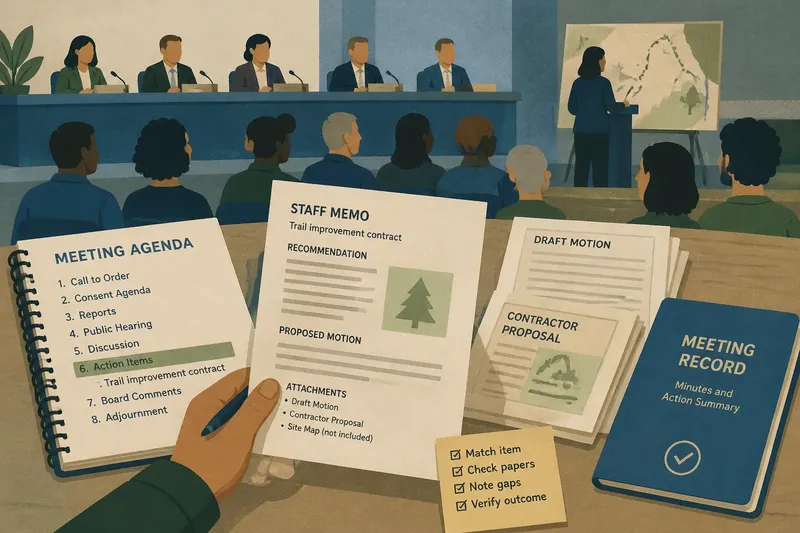
Imagine a parks board agenda lists “Trail improvement contract” under action items and attaches a staff memo recommending a contractor. The heading and memo preview a decision; if members request revisions and defer action, only the record produced after the meeting can establish that outcome.
Use attached papers to decode shorthand
Attachments often carry the detail that a heading cannot. Look for staff reports, draft resolutions, maps, proposed contracts, financial summaries, and correspondence. Each has a different job: a map can show the location under discussion, while a draft resolution can reveal wording officials may be asked to adopt.
Check the document’s status before treating it as final. Words such as “draft,” “proposed,” or “for discussion” matter. A packet may include several versions, and a recommendation in a staff memo remains a recommendation unless the record shows that the relevant body accepted it.
Match each attachment to its agenda item. Packet files may be bundled, named with abbreviations, or posted separately. Compare the item number, title, and document references so you do not mistake a background paper for the proposal itself.
If a paper cites another report, drawing, or exhibit that is not attached, note the gap. That can help you ask where the referenced material is available. It does not establish that the item is incomplete or that officials will consider the missing document during the meeting.
Prepare a focused reading path
Use these checks to connect the agenda, packet, and later record. Each result points to a practical next move.
- Check the meeting body and date. If the agenda matches the council, board, or committee and meeting you intend to follow, keep reading; if not, find the correct meeting page before relying on its item details.
- Check the item number and exact heading. If both appear in the packet, use them to match the supporting papers; if either is missing or differs, compare the agenda versions or ask the issuing office which item the document belongs to.
- Check the agenda category. If the item is marked for information, discussion, hearing, or action, use that label to understand its stated purpose; if no category is shown, read the item description and governing meeting rules rather than guessing.
- Check the linked papers for status words. If a document says “draft,” “proposed,” or “for discussion,” treat it as a proposal or working paper; if it is identified as adopted or final, still verify that it belongs to this item and meeting.
- Check for a proposed motion or resolution. If one is attached, read its wording to identify the specific choice before the body; if none appears, do not infer that no decision is possible—consult the agenda description or ask the clerk’s office.
- Check each cited report, drawing, or exhibit against the packet. If it is present, match its title to the reference; if it is absent, note the title and ask the issuing office where to find it rather than assuming it will be considered.
- Check the official record after the meeting. If minutes, an action summary, or an adopted document states the disposition, use that record to describe what happened; if the item is not covered, search by its number and subject or ask the body’s records office.
Say you are following a parks board agenda with item 6, “Trail improvement contract,” and a memo labeled “staff recommendation.” You match item 6 to the memo, find a draft motion proposing approval of a named contractor, and notice that the motion cites a site map that is not in the packet. You note the missing map and ask the clerk’s office where it is posted; after the meeting, the minutes say the board postponed item 6 for revisions. The resulting answer is clear: the proposal was considered but not approved at that meeting, and the revised proposal will need to be tracked in a later agenda.
Know what an agenda can and cannot tell you?
Does an agenda item mean a vote will happen?
No. An item may be listed for discussion or possible action, and the body may defer it, amend a proposal, or take another course. Read the stated purpose and check the meeting record for what followed.
Is a staff recommendation the same as an official decision?
No. A recommendation describes what staff propose or advise; the authorized body may accept, revise, reject, or postpone it. The record of the meeting indicates the action taken, if any.
Where can I find out what happened after the meeting?
Look for the meeting minutes, action summary, adopted resolution, or another official record issued by the body. Which document provides the clearest account depends on that institution’s recordkeeping practices.
Can the agenda change after it is posted?
It can be revised or supplemented under applicable procedures. Check the issuing office’s meeting page for later versions and notices; rules about changes, timing, and public notice depend on the institution and local requirements.
Return to the record after the meeting
Minutes are usually a concise account, not a transcript. They may identify who attended, summarize discussion, record motions and votes, and note whether an item was postponed. If you need the precise wording of a motion or a fuller account of proceedings, check what other records the body keeps, such as an audio recording or adopted document.
Compare the final record with the agenda rather than assuming the original packet tells the whole story. The item may have moved, changed title, been amended, or been handled without a final decision. Search by both its agenda number and subject if the record uses different wording.
For a topic you expect to follow over several meetings, save each agenda alongside its corresponding minutes and attachments. Reading a public meeting agenda tells you what officials planned to consider; matching it with the official record tells you whether the matter advanced, changed, or still needs attention.